
Red Creek Wildlife Rehab Center
PA Mag- Red Creek Rehab Center etc.
I found a majestic redtail hawk just standing on the side of my path. It did not move as I slowly grew closer. Feathers stuck out weirdly from its one wing. It was injured and looked in distress. I snapped a few photos and called nearby Hawk Mountain Sanctuary for advice. “Call ‘Wildlife in Need Emergency Response of PA’” (WIN), I was told. It is a volunteer, non-profit, statewide network for capturing and delivering injured, and orphaned wildlife within the state of Pennsylvania. They advise concerned citizens on wildlife situations they encounter, and respond to wildlife needing to be captured. Based in Erie, the folks at WIN located my closest wildlife rehab and got ahold of them for me.
In my case, it is Peggy Sue Hentz of Schuylkill County’s Red Creek Wildlife Center. Peggy met me and after gathering a cloth bag and a leather glove, we walked in until we found the hawk still standing stoically. When Peggy grew very close, it glided down a steep ravine, unable to flap its fractured wing. Peg trooped down the slope after it and when she got to the hawk, sat down right next to it. She spoke quietly to it, then took hold of its talons and enveloped it in her arms. She had to carefully navigate the steep slope by traversing it on an angle as she only had one hand to steady herself as she climbed. It was moving to see how hard she worked to help the broken hawk.
This wasn’t the first time we called on Peggy to help with injured animals. When my children were young, a Great Blue Heron dropped out of the sky and into our garden. When we cautiously approached it, it did not try to step away, but only bent its elegant neck away in fear, unable to move. Inability to escape is usually the first sign that an animal is in trouble. Any healthy adult animal will not allow itself to be captured or handled.
I called Red Creek and Peg told us how to get it into a box to bring it in. To catch it, we had to protect ourselves from its slender bill wielded like a dagger in self defense, targeting our eyeballs.They strike at the eyes to blind their enemies, or their saviors. Our whole family pulled on hoodies and tightened the strings around our faces, knotting it so we could only peer through a tiny hole through safety goggles.
The poor bird was so disoriented, my husband Todd merely walked up to it as we came in from the sides and tipped a 5-gallon bucket over it. When Peggy opened the lid at the rehab center, she swiftly grabbed it by the bill and curled its stick-like frame into her armpit. Peggy was convinced it had been poisoned. She gave it an antidote injection and hoped she could revive it within a couple of weeks. We gave her a donation towards the care of the bird. This rescue was a wonderful learning experience for our children. It taught them empathy and gave us tools on what to do should we encounter a wild animal which appears abandoned, injured or orphaned.
Back then, Peggy worked out of her modest modular home as a wildlife rehabilitator on a 3 acre property which she purchased in 1988. She had cages scattered around her property, housing an assortment of wild creatures she was tending to. She was working on a shoestring, and was grooming dogs as a source of income to support her passion of helping wildlife. She applied for permits to become a wildlife rehabber and in 1991, passed the state tests. Back then there were no classes, no study material, no aps. Things have changed over the last three decades, for Red Creek and for wildlife rehabbing in the state of Pennsylvania and beyond, and much of that has to do with the tireless work of Peggy Hentz.

Red Creek Wildlife Center is one of 26 rehabilitation centers located in the state and Peggy is one of 30 rehabbers. Eastern PA is well covered but the central is skimpy and the west is even slimmer. Centers range from makeshift facilities out of the rehabber’s personal home, or have a separate space with no paid staff and are very limited, to the state of the art at Red Creek, which admits over 4,000 animals a year. There are three other licensed rehabbers at Red Creek besides Peggy, as well as volunteers and interns from Kutztown University and Delaware Valley University, majoring in wildlife or fisheries.
I paid a visit to Red Creek and Peggy gave me a private tour of the rehab. The main building is called “The Bostiber Clinic,” which gets its name from a foundation in Media, that supports animal welfare projects. The Foundation’s Administrator has a sister, who found an injured starling. She called many rehab centers but no one would help it because the starling is “invasive.” Then she called Red Creek and Peg said, “Sure. Bring it in. A life is a life.” This was the start of their relationship. Down the road, they talked to an architect and helped them design and finance this 4,500 sq ft rehab hospital.
There is an intensive care room where the animal is examined and evaluated when they first come in. The wash room is the dirty area where they power wash cages and food bowls etc with disinfection in-between animals. There’s the lab & X-Ray Room. They can do their own lab work and X-rays, then e-mail them to a vet if they need consult. Most of the treatments they can do right here, just not surgery, except for some orthopedic surgery if bones are broken. All of the animals brought to Red Creek are triaged, treated for medical issues, cared for, fed, and if possible released.
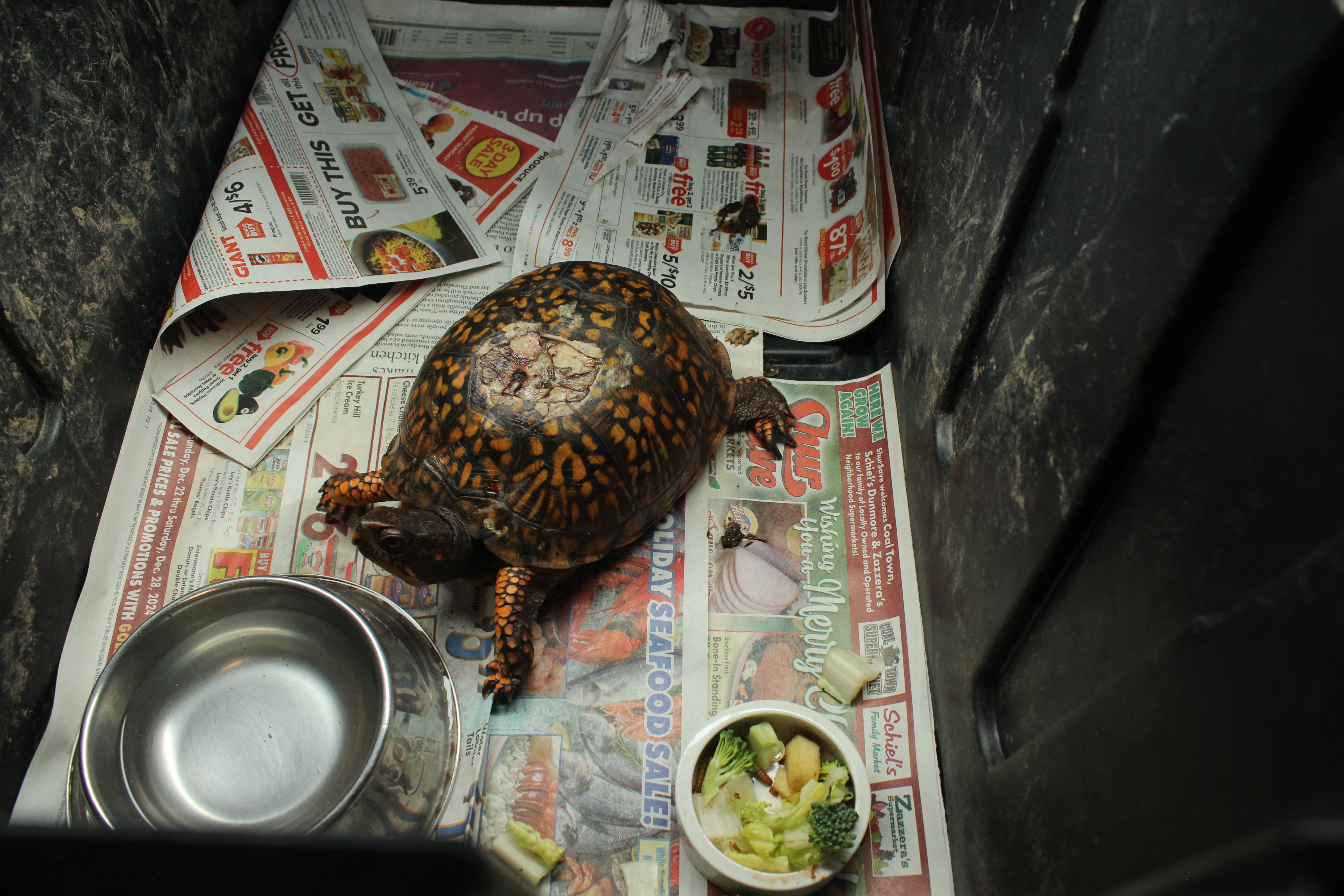
Peggy introduced me to some of the animals. A fox is in on oxygen from a head injury after being hit by a car. A few injured box turtles and a snapping turtle were in their own separate containers like plastic kiddie swimming pools. “Turtles come in with eye infections, and broken shells from lawnmowers and vehicle collisions but they are capable of making some of the most incredible recoveries. Their shells heal just like bones. Some are taped close. Others have antibiotic ointment smeared on their shells. Everything is slow with turtles, living and healing.”

She showed me the baby possums and one adult, who fosters babies “He was imprinted and grew up with people so he is staying here permanently. We do not condone imprinting. It never helps a wild animal to raise or feed it anything.”
“This American kestral was dive bombing people when he was called in. We figured he was imprinted and released and was starving…trying to get humans’ attention to feed him.” He is currently being trained to become an ambassador and add to the programs Red Creek gives at schools, fairs and other events. Some of their non-releasable animals work as education ambassadors, some act as surrogate parents for babies of their species, and some do both.
Peggy says, “Young wildlife have very strong instincts, and despite being rehabilitated by humans, they can still learn how to hunt, fly, and thrive in the wild. However, when we have the opportunity to provide a foster parent for these babies to grow up with, they become much more comfortable and those natural instincts shine through.”
Gabby, a 33-year old Great Horned Owl, is Red Creek’s mascot and is the first non-releasable ambassador. He has fostered many young great horned owls in over 30 years at Red Creek. To have the opportunity to grow up with Gabby and have a parent during the most impressionable months of its life, is very important and valuable for an owlet.
Mazie, a common raven, is one of Red Creek’s newest residents. She is non-releasable due to a wing injury. When a young raven arrived after falling from its very high nest, Mazie was immediately infatuated with the baby, and after it had stabilized, the two were introduced and housed together, and now they are like family. Ravens are highly social animals and have strong family bonds, so this pairing is extremely valuable for both.
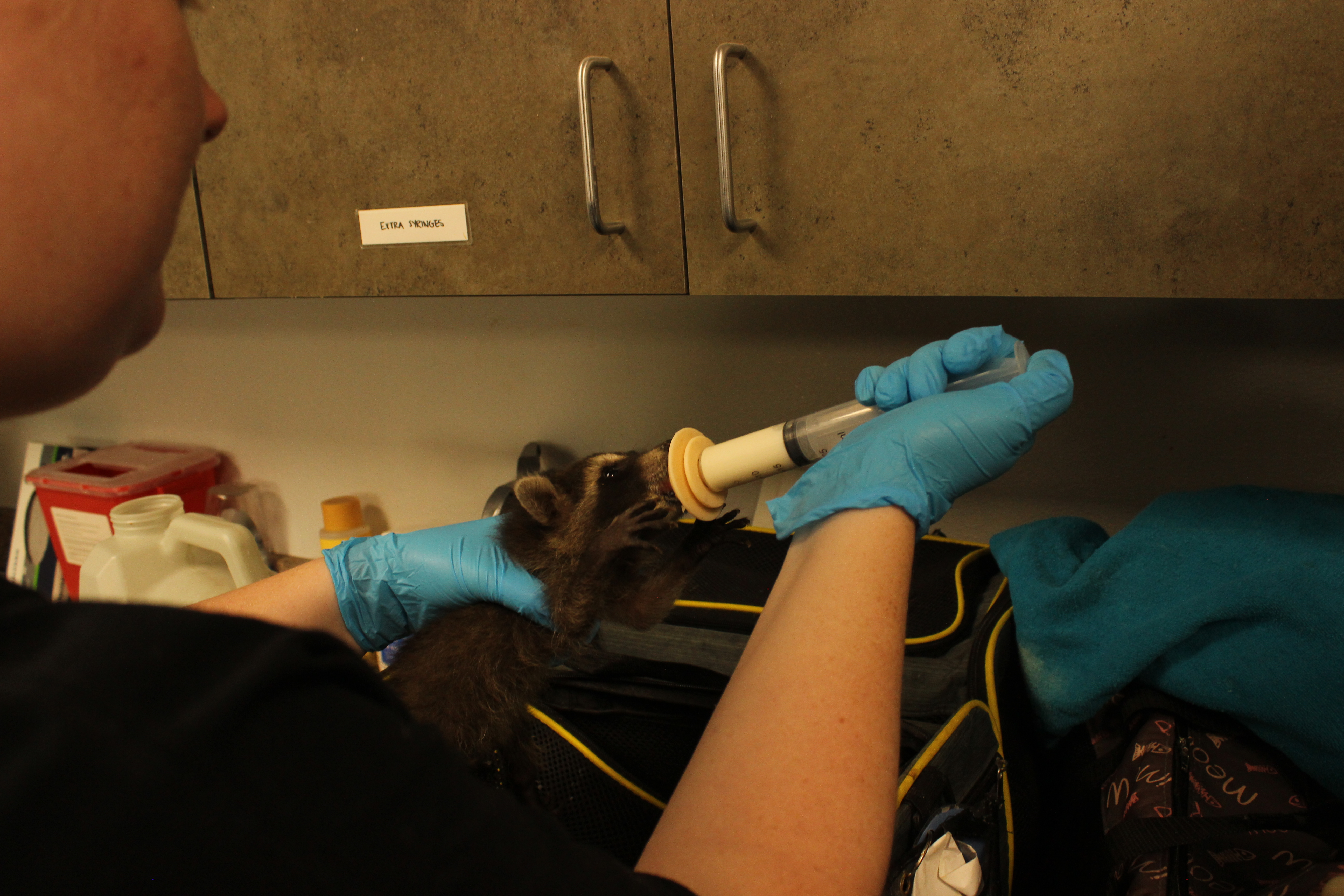
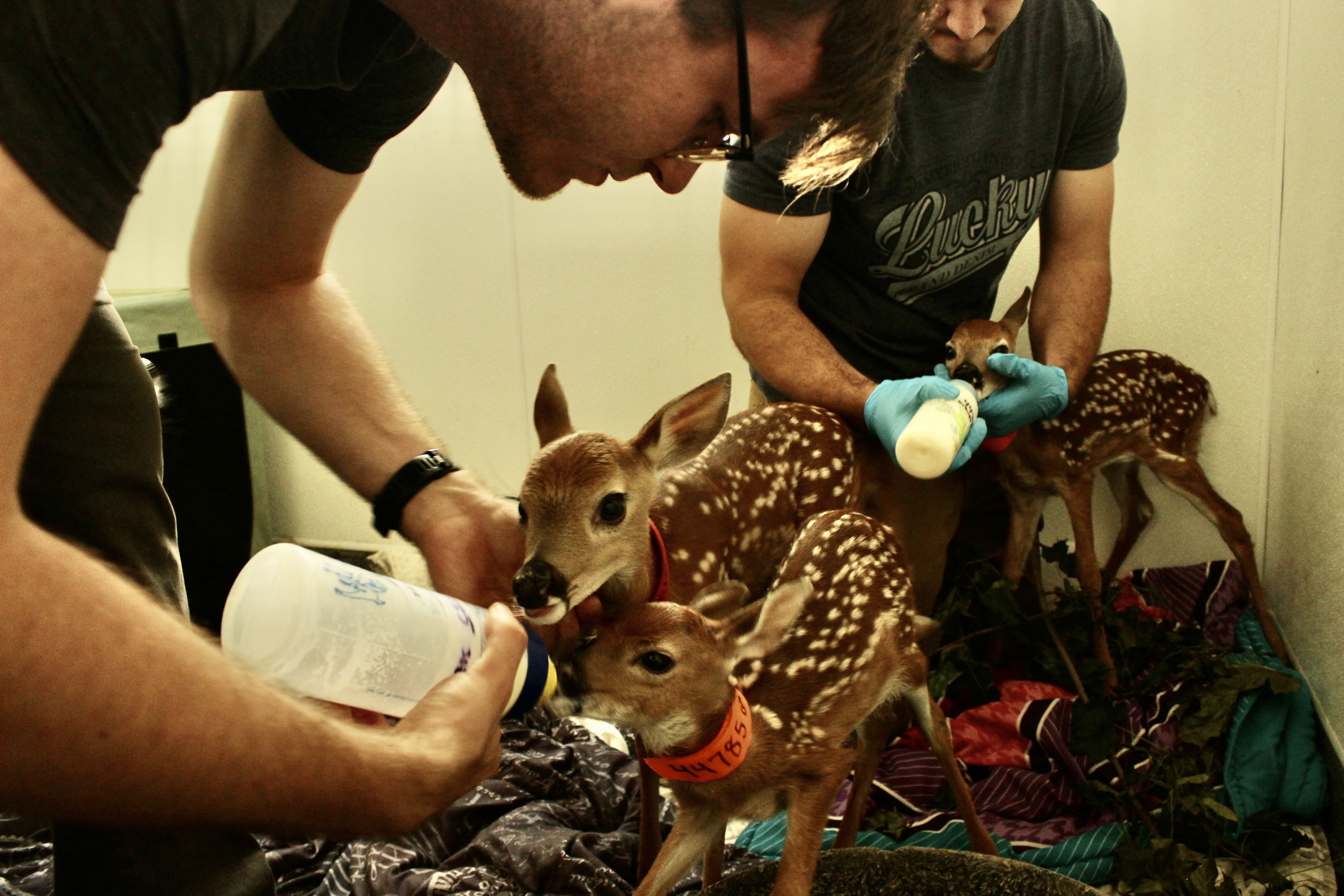
In one room, a technican was feeding a slurry of mixed insects to baby birds with an eye dropper. In the fawn room, two techs were bottle feeding fawns who truly were abandoned when their mothers got hit by vehicles on the road.“Rescuing” so called “abandoned” fawns runs rampant at this time of year. They get over 100 calls a season just on fawns. It is helpful to understand the biology of the whitetail fawn so together with the wildlife rehabber, you can make an accurate decision, and then transport it. “We question people at length when they call in about fawns. We do our best from preventing people from kidnapping baby animals.”
In baby animal season, May-June, they sometimes admit an average of 200 animals every week. Recently, 14 baby opossums arrived that were all from one mother who’d been killed by a vehicle, and whose pouch still contained the young ones who needed immediate support. A typical day might consist of bottle-feeding newborn raccoons and groundhogs, releasing juvenile rabbits, teaching young birds to fly, and caring for the hundreds of animals that are being rehabilitating. There can be anywhere from a few hundred animals at the center, or upwards towards 1,000… all fragile, helpless, and completely dependent on the folks at Red Creek for survival. Work is nonstop.
“June is big brown bat pup season,” Peggy says, “and these kiddos typically arrive in critical condition. These tiny sky puppies need very intensive care, feedings every 2 hours around the clock. Our staff members who care for them spend many restless nights and on shift hours making sure they are getting fluid therapy, have full bellies, and are maintaining healthy growth. Bats are essential for our ecosystems in many ways. Just like all other animals native to Pennsylvania we care for, they deserve our love and time.”
The staff does not end their work day at 5 but carry tote bags home containing rescued baby animals that require around-the-clock care, feeding them throughout the night. Nestling songbirds require feeding every 30 minutes from sunrise to sunset. Opossum joeys get tube-fed every few hours.

I paid a visit to the Nature & Education Center, which is open to the public on weekends, 11-3 Sat & Sun. There is a classroom where trainings are held and many taxidermic animals are on display. Some species came to the center alive but they were unable to help them. Some were donated by a local taxidermist. They also have a live possum, a snake and a pigeon at the center. All are non releasable.
Andy and Carol Muller of Reading Blue Mountain & Northern Great Northern Railroad based out of Hamburg, PA financed the education center. For the past twenty years, Andy has supported half of the money needed to run Red Creek, a hefty bill, as it needs $40,000 of rodents alone every year!
From here, we paid a visit to the enclosures where the big birds, etc. are. These are horse run-in sheds that were retrofitted as big flight cages: a broad winged hawk, a barred owl, the silver phase of a red fox, etc are housed here. Visitors can come and see them when they are open on the weekends.
“This has been my dream my whole life,” Peggy tells me as we look over the center’s non-releasable educator animals. “Animals have been my passion since I was little.”
“A story my mom tells is when I was 5 years old, I found a kitten that was about 4 weeks old. It was sick and as the day went on, it got sicker and weaker. My mother told me that I could not keep the kitten, so I went door to door in my neighborhood in Orwigsburg, to everyone I knew, asking if they would take it in. I would come every day to feed it and clean the litter, I told them. I got no takers. Then I broke a big promise and crossed the street on Market and went to houses of people I did not know. My story struck a cord with June Zulick, a wealthy woman who owned a shoe factory, and she took it in. I imagined the kitty sleeping on satin sheets and June called it “Tinkerbell.” People were calling my mother and telling her what I was doing. I was sent to bed but announced, ‘When I grow up, I’m going to buy a home in the country so I can rescue all the animals I want and you can’t stop me.’ Many years later, after Red Creek was thriving, my mother said to me, ‘You know Peggy, you kept your promise.’”
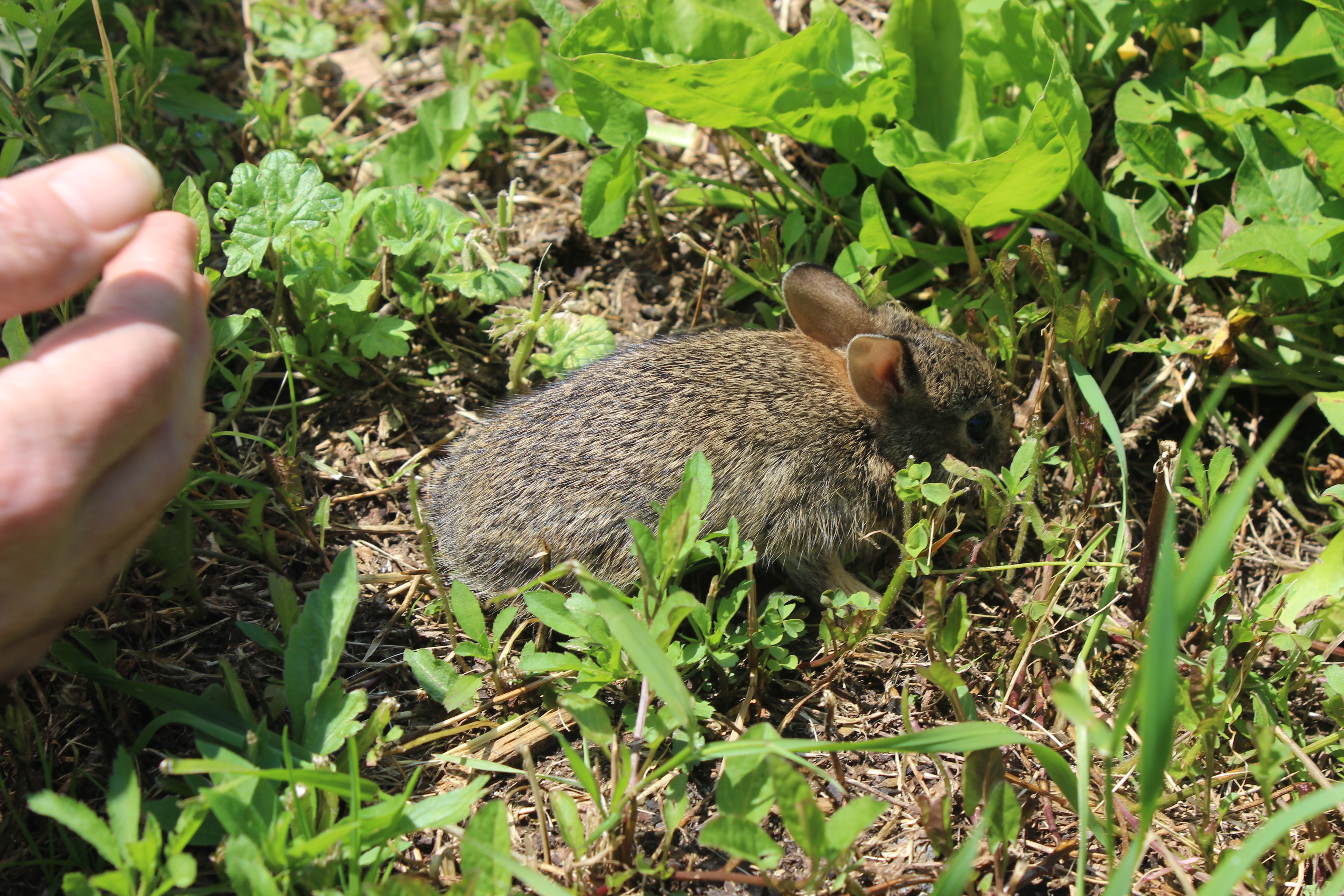
Peggy has written a few books to help rehabbers or the general public learn to better help injured and abandoned wildlife. One is solely about raising baby bunnies as their success rate for raising them is very low- 1-20%. They are an animal that thrives where the forest meets the fields. There are no longer many edges along the fields for them to live and hide in. They can live on untreated lawns but the beautifully manicure lawns with no dandelions that have been poisoned to kill the grass, cannot sustain bunnies. Caring for lawns like this is detrimental to wildlife.
“All of the baby bunnies come home with me,” she says. “I have raised and typically release 1,000 bunnies in a year! Before you leave,” she tells me, “I have baby bunnies to release that are going back to nature. It is a great time of the day to release baby bunnies- (about 1 pm). Now they smell like humans, but by sundown, it will absolutely be gone. They will be odor camouflaged. When the night time predators come out, they will be calm and bedded down and remain right here. Their scent glands have not developed yet (nor a fawns). Not until they are older when they can out run their prey. ( 2 months old – bunnies; 2-3 months old- fawns). She tells me to watch my step. She released 6 today, and 20 before that. She gently nudges the bunnies forward, for their are reluctant to leave.
Wildlife rehabbers work closely with the Pennsylvania Game Commission, whose mission is to manage Pennsylvania’s wild birds, wild mammals, and their habitats for current and future generations. If someone finds an injured animal, and they want to help, if rehab did not exist, and there was no legal service like wildlife rehabbers, they would take the animal home, break the law, and perhaps subject their family to zoonotic diseases like rabies. For example, someone found baby raccoons that the family wanted to raise themselves. Some tested positive for rabies and then Red Creek got them help. Peg said in this instance, they saved a 13-year old girl’s life. Illnesses, like parasites, can also transfer from one species to another and infest their pets. They could possibly torture the animal from lack of knowledge. Rehabbing is a public health service. The PGC is very thankful that the rehabbers are there to help take calls and offer guidance. The rehabbers are available 24/7 and are not done work at 5 pm and can always help with injure and abandoned wildlife.
You can also find a rehabber yourself at PAWR.com (Pennsylvania Association of Wildlife Rehabilitates). They list all the rehabbers who are licensed and what they are licensed for. Wildlife in Need is not permitted to capture deer over 30 pounds, bear, adult otters, fishers, bobcats, or venomous snakes. (Pocono Wildlife and Rehabilitation Center is the only center that takes bears.) Locate your regional Pennsylvania Game Commission at pgc.pa.gov for mammals listed and your regional Fish and Boat regional office at fishandboat.com. For venomous snakes, contact Keystone Herpetology, Inc. 484-525-3512.
Peggy wrote a book entitled, “Rescuing Wildlife,” which contains many great suggestions of what to do should you encounter a wild animal that is orphaned, injured or abandoned. She offers practical ways to help wildlife, from adjusting mower blades high and first walking the area to look for bunny nests. Avoid using pesticides on your lawn, do put caps on chimneys, check trees for nests before cutting down, check for animals nesting in car engines if not driven for awhile, etc. The book tells you what to do if you get bats in your home, or encounter injured turtles on the road, or if a bird gets trapped in a building, or if you find baby birds that fell out of their nest, or whole nests falling, or if animals get stuck in fresh tar on a driveway, etc.
Peggy suggests assembling your very own wildlife emergency kit to keep in your car. These situations often arise quickly, so the last thing you want is to be unprepared. Here’s some good things to keep with you:
A cardboard box that can be closed/with a lid or a storage tote
A blanket (an old t-shirt or hand towel will work for small animals)
Latex or nitrile gloves
Gardening or work gloves, if you have them
A phone to call your local rehabilitation center for advice!
Accidents happen, especially with these small, quick animals darting into roadways. As always, keep an eye out for injured wildlife along the roads and if you find any in need of help, contact your local rehabilitator!
Peggy also created a new APP for rehabbers, “The Wildlife Rehab Assistant.” Students buy memberships to get access to all of the training they developed, including instructional videos. Peggy is the only one doing this kind of outreach work. As a college student in wildlife biology or fisheries, they only get one or two classes in wildlife rehab. Rehabs can now start out with more knowledge and have less trial and error.
Although there are twenty other rehab centers in PA, Red Creek is in a class all its own. “There are three parts to my mission: rehab, public education, and training for rehabbers. She has helped so many and assisted them by sponsoring them as they opened their own facilities as well as helping them raise money, which is the hardest part. “The cost of saving these lives adds up quickly,” she said. “It takes a community of caring individuals. The centers are heavily reliant on donations to cover overhead expenses, salaries and pay for things ranging from specialized formula and food to medical care and proper enclosures,” she said.
“The work is exhausting but rewarding,” she shares “Watching a once-fragile newborn grow into a fearless, healthy juvenile ready to return to the wild makes every effort worthwhile,” she said. “Or watching a raptor take their first real flights is nothing short of inspiring,” Every sleepless night is worth it.”
( a version of this story appeared in Pennsylvania Magazine)
Posted in: Uncategorized


absolutely amazing work Peggy and staffs do! grateful for their work!!! Thanks for this article, Cindy!
you bet honey!
Such a wonderful article about Wild Creek Wildlife Center, and it reminded me what an incredible organization they are. Thank you Cindy. I’ve taken several injured wild animals there over the years, and they have always provided them with compassionate, expert care.
Peggy, the owner, is so kind, knowledgeable, and always willing to help. It’s clear how deeply she cares about every animal that comes through their doors. Their dedication to wildlife rehabilitation is truly inspiring.
I’m also a big fan of Gabby the owl, I even have a Gabby sticker on my car! Thank you, Wild Creek Wildlife Center, for everything you do to care for our local wildlife. Your hard work and compassion make a real difference in the lives of so many animals.
thank you very much for your kind waords
Very interesting – thanks Cindy. Barbara
>
you bet- hope you are well
Thank you, Cindy. ❤️
Over the years, many people have written about Red Creek, but this remains one of the most accurate and complete articles I’ve ever read about us. You captured not only what we do, but why we do it. That’s a rare gift.
Thank you for taking the time to truly understand our work and for telling our story with such honesty, heart, and care. I’m honored that you’ve shared it again, and grateful that your words continue to introduce people to Red Creek.
thank you for these very kind words- people like you make my job as a writer, a joy. Thank you do sharing your story and all you do to help the critters.