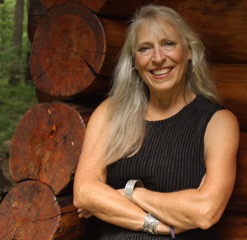
The Magic of Good Shepherd Rehab (excerpt from my upcoming book, “The Making of a Caregiver- a Love Story”)
The first thing we see when approaching the Good Shepherd Hyland Center for Rehabilitation in Allentown PA is the bronze statue in front of the facility of the founder, the Rev. John “Papa” Raker. He is holding up a “crippled child” above his head, who is grasping her crutches. The child’s head seems to brush the deep blue sky and she appears to be weightless and flying. We stop on the sidewalk to look up at it and my throat catches. I sense there is great hope here. We are here for a tour, to set up an evaluation and then get on the schedule for regular rehab.
Inside, the sights are even more profound. We enter on the middle level where the pediatric center is. A disabled child “walks” mechanically in a motorized pacer with colorful flashing lights while the therapist’s phone plays nursery songs. A tracheotomy tube comes out of her neck but her head is up and she is smiling. The child’s mother walks proudly next to her daughter with the therapist behind, offering encouragement.
Down the hall comes an adult male patient wearing a robotized walking device. He moves slowly and methodically. There are support frames on his upper and lower legs, and around his pelvic area. The sound of little motors operating the device’s joints fill the hallway. He holds onto European style forearm crutches and a therapist holds onto handles on the back of his torso, in case he wavers. We later learn that this spinal cord injured patient has not walked in years but now can with the help of this robot exoskeleton gait trainer.
My own husband enters the facility on a motorized wheelchair but using this exoskeleton is where I want him to go ASAP. These devices are designed to allow the individual to walk and balance independently, to stand upright, walk, turn, and climb up and down stairs. What an amazing technological tool to help someone learn to walk again. Good Shepherd is where I want Todd to be.
John Raker began the Good Shepherd Home for Crippled Children back in 1908. He and his wife, Estella had just lost their young daughter, Viola in infancy. Serendipitously, when the sorrowful couple returned from the funeral, there was a letter waiting for them, asking if they could take in a crippled, orphaned girl and raise her. Her name just “happened” to be Viola too! Up until this event, the couple was running a home for orphaned children and the elderly, but not “crippled” children, and not infants.
“If a child lost its father and mother and in addition to that great misfortune, it was crippled or blind or epileptic or sickly or under three-year of age, all other orphanages at the time were closed to such a child,” so reads a quote from the book, Papa Raker’s Dream by Dick Cowen. That request letter changed everything for the Rakers. The couple saw this as a message from the Divine.
As a boy, John Raker was one of eleven children, born in a log cabin into a religious family who daily read the Scripture and looked at Bible pictures. Young John saw a picture of Apostles Peter and John going into the temple to pray and at the gate was a crippled man, begging, who could not walk. Peter said to him, “In the name of Jesus of Nazareth, rise up and walk,” and the cripple did. John Raker said to himself, ‘Would to God that I might be able to do something like that.’ From that day on, his thoughts and efforts would be in sympathy with what he called ‘the most vulnerable.’” The Rakers’ motto was “Turning tragedy into triumph.” Todd and I could use a little of that ourselves.
The idea of Good Shepherd was motivated by John Raker “to enhance lives, maximize function, inspire hope and promote dignity and well-being with expertise, innovative care and compassion.” Today, Good Shepherd Rehab has 40,000 patients a year going through their thirty different rehab sites scattered around the eastern counties of Pennsylvania. The Hyland Center for Rehabilitation and Technology in downtown Allentown, Pennsylvania is the center of the Good Shepherd rehab universe. Patients are considered family. We met a mother in a waiting area who has been bringing her son here for over 20 years off and on for rehab. “It’s our second home,” she shared. I think we might find a home here too.
The Hyland Center specializes in rehabilitating spinal cord injury, traumatic brain injury, stroke, and other neurological conditions. There are physical therapists, occupational therapists, hand specialists, speech therapists, and aqua therapists available.
When we open the glass door to the pool, the warm balmy air feels like we just deplaned in Mexico. Patients who can’t walk are being lowered then raised out of the 94 degree pool on mechanical lifts. In the five different water depths, there is an underwater bike, a treadmill, submerged parallel bars, and a deep pool for hanging with pool noodles under your armpits to stretch out your spine. Along the wall are shelves of therapy pool equipment like pastel-colored foam noodles and sand-filled ankle weights and red kick boards and plastic resistant paddles and dumbbells.
Todd and I stare at the scene before us. A young disabled child floats around on a buoyant foam pad, getting used to the water. A paralyzed man who wears a float collar around his neck and ankle weights is guided by a therapist as he attempts to move his feet one by one, underwater. Another patient with a cane in the shallow end, has a stretch resistant band wrapped around his waist. A therapist pulls on both ends of the band at his side attempting to throw him off balance as he walks across the pool floor. Three accessible family changing rooms allow the caregiver to help the patient take a shower and get dressed on a mat table that raises and lowers with a motorized foot pedal.
I am so excited to get Todd into the pool to diminish his weight and increase his buoyancy which will help make recovery easier. The water can support up to 90% of a person’s body weight, which allows for easier movement and creates less strain on muscles and joints. The very warm water allows muscles to relax and loosen up, thereby diminishing the tone which fights the other muscles when trying to exercise and move. The water’s resistance enables gentle, effective strengthening and if you happen to fall, you don’t get hurt! I’m thinking the pool is where the magic might happen first..
Next we check out the Optimal Fitness Gym which has dozens of machines, many of which can accommodate a person in a wheelchair. Seats swing out of the way to make room for the chair. There are FES (functional electrical stimulation) bikes where patients attach sticky electrical transmitter patches onto their legs and arms to stimulate muscles. The FES bike patches can either make the person’s paralyzed muscles fire and hence build strength; or, in Todd’s case, fatigue his over-stimulated, contracted muscles and tire them out, thereby reducing his tone.You can sign up to ride for an hour at a mere $5.00.
I ask some of the folks in the gym how they ended up in a wheelchair. One roller named Peter, in the standing frame says, “Oh it was bad. I was with my girlfriend and I got caught in bed by her husband. I jumped out of the window to get away. I fell into a bush but as I was running across the lawn, he shot me in the back and the bullet paralyzed me.”
Todd and I both said, “Oh My God!”
He said, “No really, don’t feel sorry for me. I deserved it.”
After a few moments of quiet shock on our part, he replied, “I’m kidding. I was in a motocross accident.”
Shortly after, we meet Tony, a young paraplegic on the leg press, who was listening to Peter’s story.
“I was running away from the scene and was shot in the back with a gun,” he tells us, “which paralyzed me.”
Todd and I joke whether we should have some fun sharing the cause of his paralysis. We could say, “It was a mountaineering accident in the Himalayas. We were roped up and I fell into a crevasse. Todd went in to rescue me but fell and broke his neck.”
Optional Fitness Gym is a lively, fun gym, mostly because it is run by Ryan Macalintel, an Exercise Physiologist, who is constantly joking and teasing the folks in the gym while he sets them up on machines and helps them. You can schedule a one-on-one with Ryan for an extra fee, where he will whoop your ass but you’ll have so much fun doing it. Everyone loves Ryan and so they come to work out and love getting fit because they love Ryan.
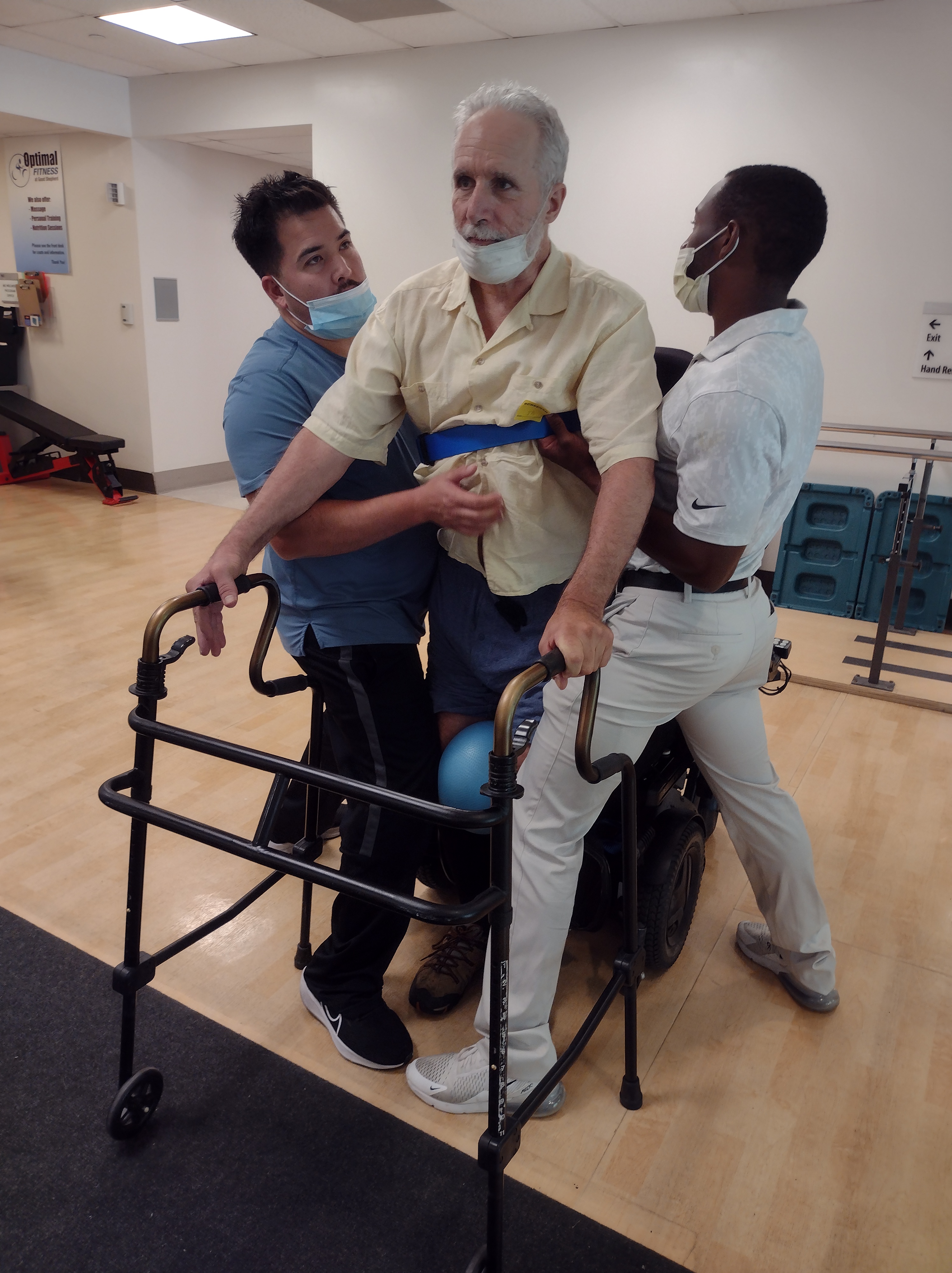
Folks who are not receiving formal therapy via their medical insurance can use the gym and therapy pool with memberships. Very often, after they are released, they return to the pool for “water walking” and work out at the gym on their own for years and years. When they need a “tune-up” with the therapists, they request a script from their physiatrist.
Todd will see a physiatrist here at Good Shepherd, a physician who specializes in physical therapy medicine and rehabilitation. Dr. Sandeep Singh will oversee Todd’s newly injured body. I look him up on the Good Shepherd website. He seems to be the head honcho, although there are others with different specialities. Dr. Singh’s is SCI, so he is our man.
We return the next week for Todd’s evaluation and to meet the doctor who will be monitoring his recovery. The therapists work to find a baseline of what his injured body can and can not do. They test his abilities, strength, flexibility, etc. They ask Todd his goals—walk again and use his right hand. They do not act as if it is beyond their ability. They are confident and we are heartened.
They are most impressed with what we have accomplished thus far— how much Todd has recovered and all the work he put into it. They pay us a great compliment— “Todd is farther along in his recovery when he arrives at GS than most spinal cord patients are when they are discharged.” We are thrilled. And this is Todd and our son Bryce’s doing—a testament to how hard they have been working. I’m very proud of my boys. Think of the places we’ll go!
THERAPY AT GOOD SHEPHERD
In OT, the therapists at Good Shepherd that right away making much progress with Todd’s compromised right hand. He is able to pull pegs off of a surface that were suction cupped and then put them in a container…the kind of exercises he used to do with his left “good” hand. They get Todd’s right hand so stretched and loosened up that he is able to touch his thumb and index finger together. Tonight while eating his ice cream, he takes that right hand and uses his fingers to stabilize his lightweight ice cream bowl which is moving around his table. Bryce points out that this seemingly small action— using his right hand in normal life, is huge. I also tell him from now he is going to use a dental pick and floss his own teeth, which he discovers he can do all by himself except for his molars.
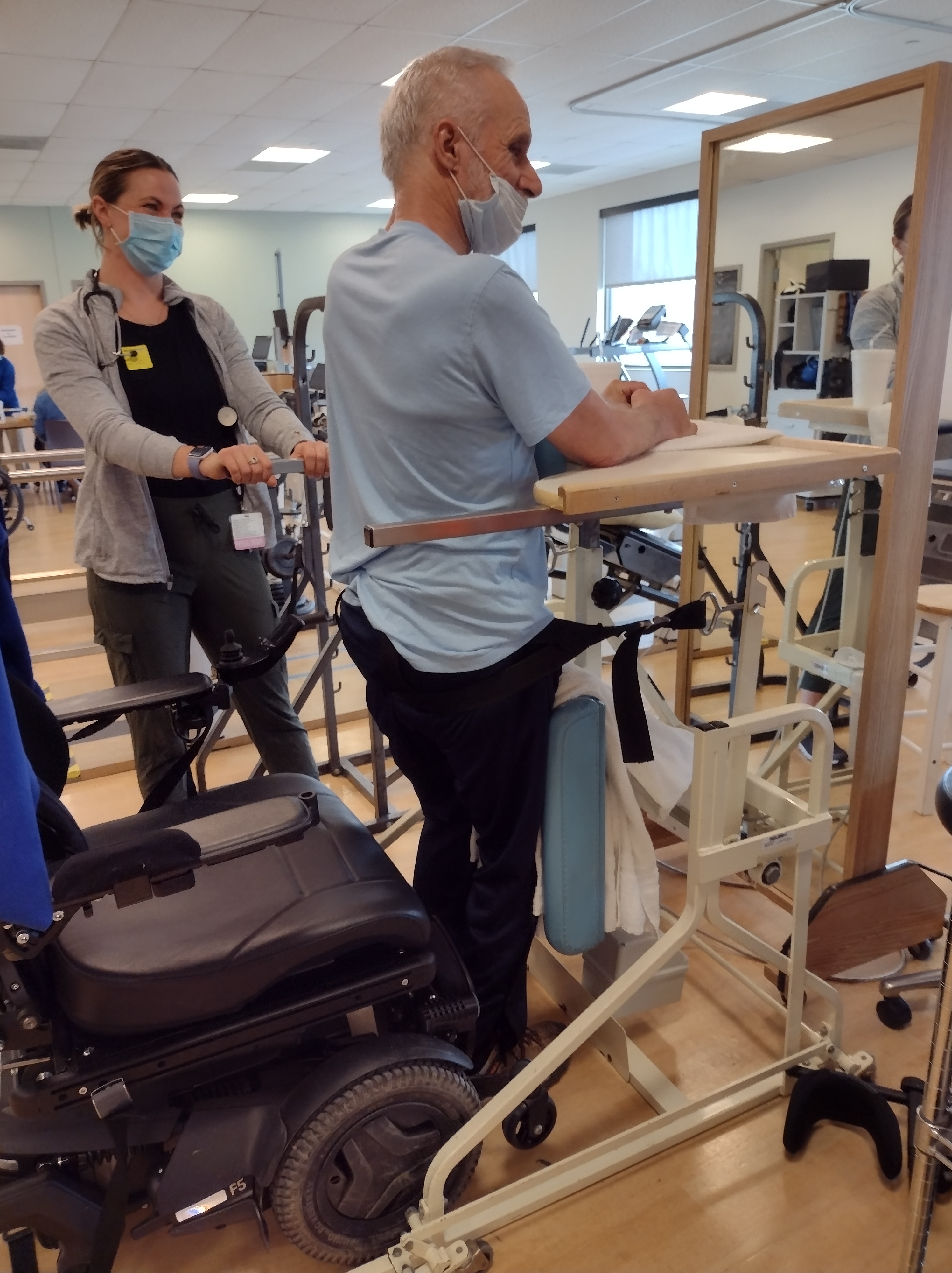
In PT, Todd gets on a machine called a MOTOmed- a motorized exercise trainer, to first loosen up. They are also training his body to handle a standing frame, to get used to standing. A standing frame is an assistive mobility device that supports individuals with limited mobility in an upright, weight-bearing position using adjustable pads, straps, and a secure base. The frame allows for controlled, assisted standing, encouraging weight-bearing through the legs even for those with little to no muscle tone. This increases bone density, improves joint range of motion, and boosts circulation. A standing frame also aids in digestion and bowel function by relieving pressure.
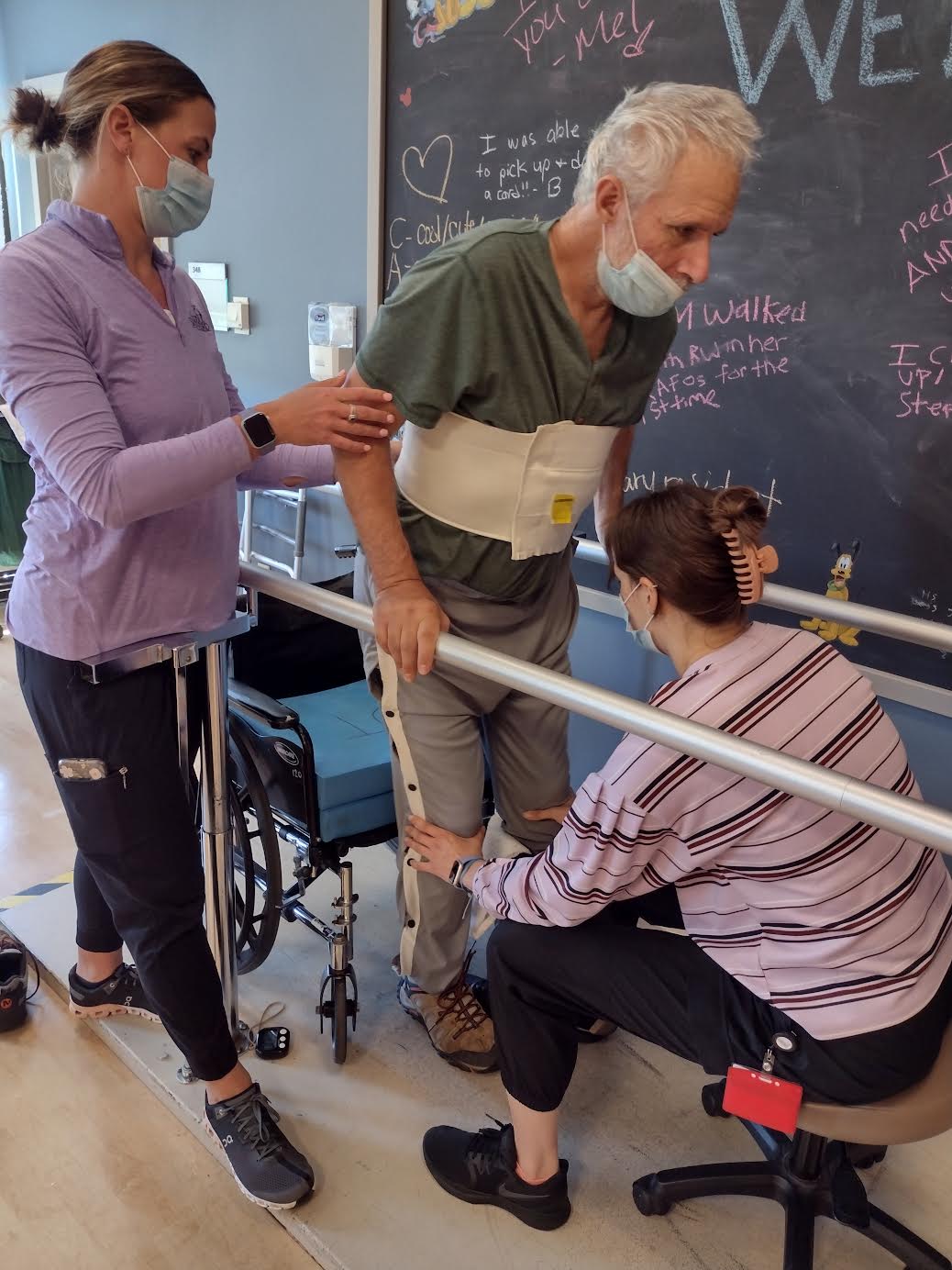
The therapists must manage Todd’s low blood pressure in the standing frame; it tanks when he first stands up. However, by using an abdominal binder, compression socks and meds, he can manage the orthostatic hypotension. It’s been so long—months, since Todd was upright for any length of time. The more he stands upright, the more he can. By June, 2022, he is standing for an amazing 45 minutes at a time.
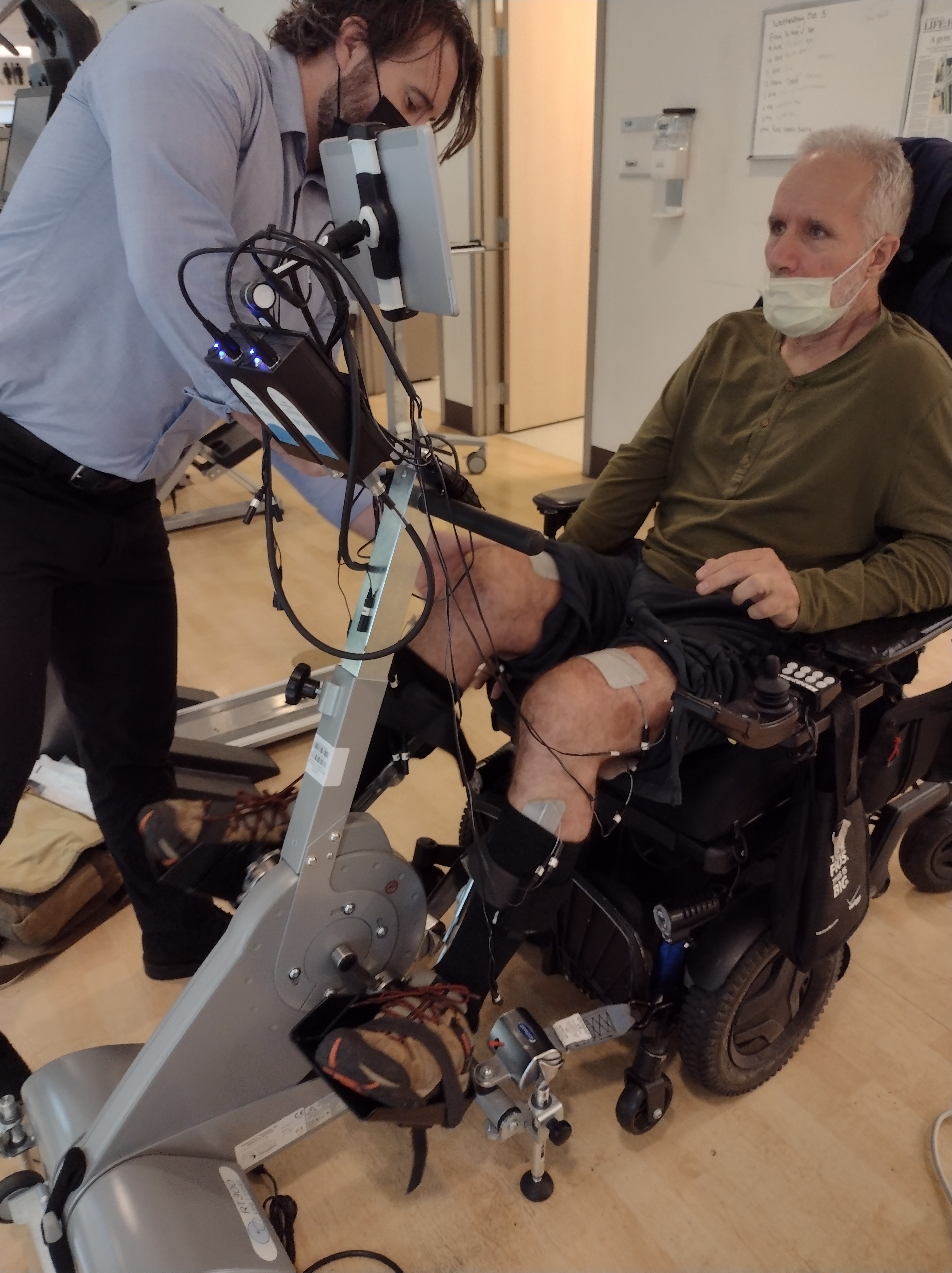
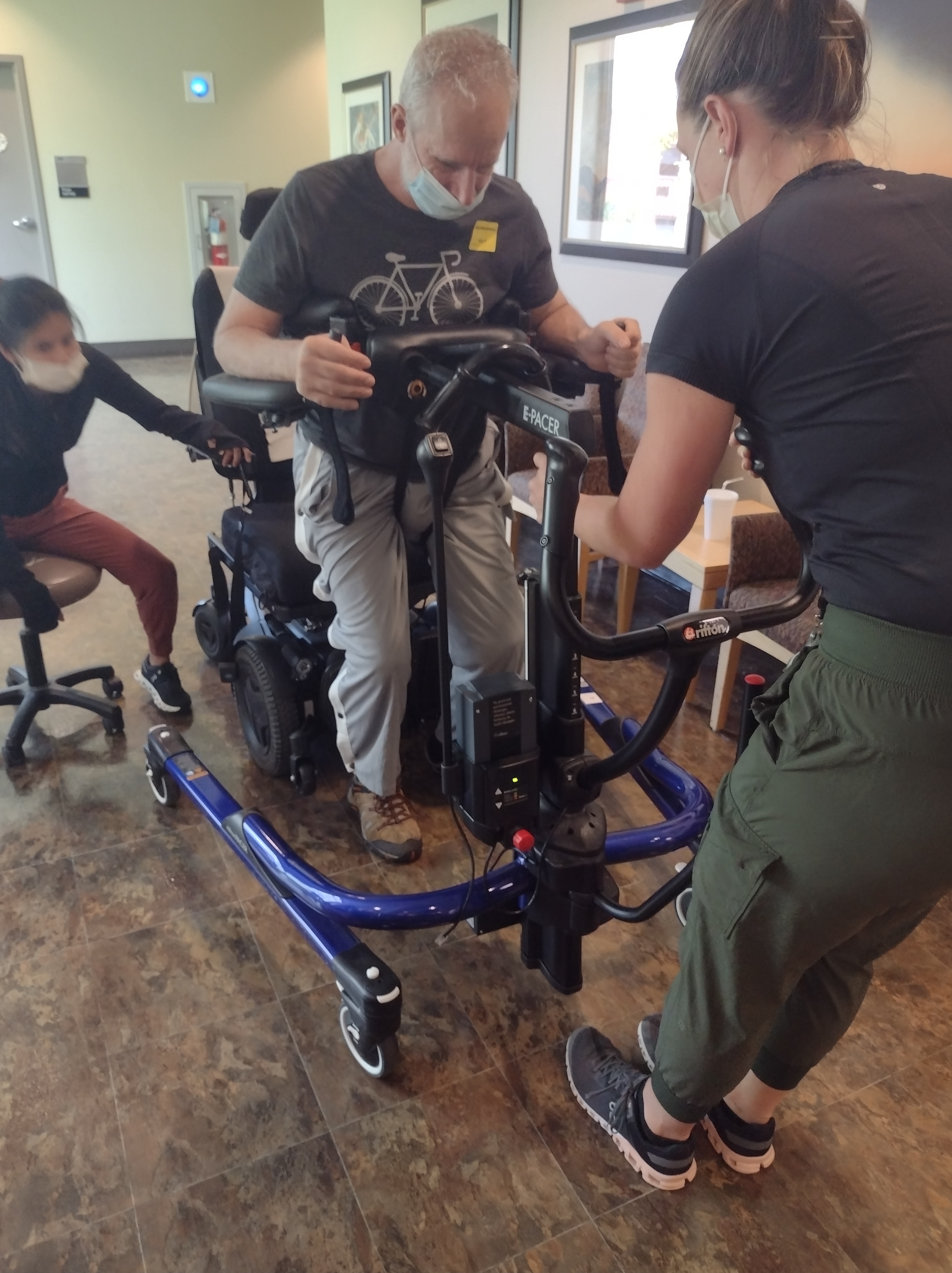
We are learning that Todd’s body is not a good candidate for the exoskeleton, the robot walking device we had our hearts set on for walking recovery. You have to be able to go at least half an hour without debilitating spasms. It’s monumental getting a SCI all suited up and if Todd can’t maintain it for any length of time, it won’t be worth it. His therapist is going to try another walking aid, however, a Pacer gait trainer.
The Pacer is a mobility and transfer device used to facilitate standing and then walking for those who lack the strength and the ability to walk with a walker. In the device, Todd’s trunk is stabilized and there is pelvic support as well as forearm support. Todd does not do well at first. It is excruciatingly difficult to simply raise his leaden body out of the seat to a semi upright position before he can even begin to take the first steps. He feels nauseous and lightheaded, but they go slowly and are not discouraged.
I miss this first attempt as I am out walking in the park but the very next therapy session I stick around to watch the miracle unfold. I can see the tremendous exertion in his face as he tries to move his body and my heart goes out to him. I cheer him on along with his two therapists— one to roll the machine forward and another to work his feet taking steps, but they keep trying, and before long they are successful and he is on his way to walking!
After he makes it back to his wheelchair and sits back in the comfortable seat, he let’s out a big sign and his face fills with pride and happiness. He is on his way! On the drive home, he brings up the Pacer multiple times and I know he can’t get his success of his mind. The light is getting through the cracks.
Posted in: Uncategorized
 Cindy Ross
Thanks Cindy – looks so interesting, but lots of commitments here (all fine) this week so will read next week and get back to you. Best wishes to you both! Barbara
>
Cindy this is amazing. I couldn’t st
Wonderful, wonderful, wonderful. My only question is: How long does insurance cover treatment like this in such a stellar facility? I know you once blogged about having to renew insurance but since then it seems to be kicking in indefinitely. Is that correct? Might want to add something about this in the ms. Carolyn
Tod has had three types of insurance- Medicade for low income, Affordable Care Act ins before he qualified for Medicare (2 yr post injury) and now Medicare and Supplemental Ins- Typically, with Medicare- if your doctor writes a script for rehab and you continue to make progress, they continue to pay. In our case, we take breaks and come back for a “tune up”
another reason to make the comment “gratitude” at the end of the Good Shepard chapter.
Thanks for sharing this excerpt. l like your background on Good Shepherd and descriptions of feelings, struggles and successes for both you and Todd. I look forward to reading the rest of your story!
thank you!!